UW-Stout Polytechnic design students use cutting-edge 3D concrete printing technology to create unique furniture
Industrial, interior designers apply learning to overcome challenges
Photos attached
FOR IMMEDIATE RELEASE
Nov. 12, 2026
MENOMONIE, Wis. – The advent of 3D concrete printing technology has designers at University of Wisconsin-Stout Polytechnic thinking big – and small – about how to push the technology to new frontiers.
The 3D concrete printing (3DCP) technology – which uses a robotically controlled nozzle attached to an extrusion hose to form concrete shapes – can rapidly create large structures such as residential and commercial buildings. Yet it provides an opportunity to use concrete in less-than-traditional ways, too.
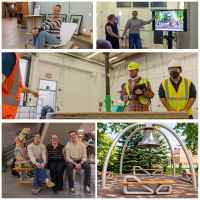
Among those uses is creating furniture, something UW-Stout Polytechnic B.F.A. industrial and product design and B.F.A. interior design students have done this semester. By adding the university’s recently acquired Alquist 3D concrete printer to their toolkit, they have expanded their creative possibilities, fabricating outdoor benches, end tables and even a lounge chair by combining concrete with wood, metal and fabric.
“As designers, and as design educators, it's our job to question what is traditionally being done and explore new possibilities for materials, processes and technologies,” said Associate Professor Dan Neubauer, director of the industrial and product design program. “Projects like this give students a chance to experiment, fail, adapt and discover. If we only use new technology for its most obvious purpose, we miss opportunities to learn what else it might be capable of. Some of the most interesting innovations come from asking, ‘What happens if we try this instead?’”
Neubauer is teaching one section of this fall’s furniture design course, while Lecturer Matt Bruhn teaches another. They are among the UW-Stout Polytechnic faculty and staff members who have learned to use the 3DCP technology and are integrating it into the university’s programs.
UW-Stout Polytechnic is one of the first universities in the Midwest to acquire 3D concrete printing technology through a strategic partnership with Alquist, a leader in the industry. Applied learning, such as using cutting-edge 3DCP tools, is a key component of Stout’s polytechnic mission.
The new technology has also allowed UW-Stout Polytechnic to become one of the first educational institutions in the United States to create a 3D Concrete Printing Certificate program. The certificate program will boost workforce skills by providing foundational expertise for both undergraduate students and professionals looking to add high-demand skills to existing careers.
Students find creative solutions
B.F.A. interior design major Sydney Lipsh, a junior from De Pere, said the 3DCP furniture project taught her lessons about collaboration, resilience and problem solving.
The first problem she and her classmates had to solve was which campus location would benefit from new concrete-containing furniture. Lipsh’s team – which included fellow interior design majors and Cassie Gurka and industrial and product design major Jackson Killinger – chose the Bell Monument on the campus’s South Lawn, aiming to create updated seating that would attract people to a beautiful but underused spot.
To avoid the boxy, rectangular shapes most associated with concrete, the team instead designed a bench that includes a pair of concrete trapezoids: a smaller one supporting the seat, another wrapping around it to create a back or elbow rest.
“The angularity of the concrete leads your eye upward,” Lipsh explained while describing the completed bench after a class presentation. Yet before that final product could be realized, the students had to contend with a new, relatively unfamiliar material.
“I think the hardest part was just trusting that the concrete would work with us and that everything would come together the way we wanted it to,” Lipsh said.
At first, that didn’t happen: The team’s initial concrete print failed, the piece collapsing on itself because its shape could not accommodate a support piece while it dried. The students had to put their heads together to develop a solution. Lipsh credited Killinger with tweaking the design to include an asymmetrical opening that allowed a support to be inserted during the printing process to stabilize the structure.
“This adjustment helped us create our final successful concrete print, and we learned a lot from the failure of our first design,” she explained.
“I feel like moving forward, it’s going to get easier,” Killinger said of using 3DCP technology. The cross-disciplinary collaboration came naturally, he added.
“I think it was actually pretty seamless,” he said. “It was close to a real-life team.”
Students focus on human-centered design
While some students looked outside for design inspiration, others turned indoors. Senior Klaire Johnson, an interior design major from Wabasha, Minnesota, said her team focused on replacing an item of furniture that is practically the opposite of concrete: a bean bag chair, like the ones found in the Swanson Library & Learning Center. They created what they called the Laze Lounge – a relaxing, low-to-the ground chair with concrete supports, a steel frame and a nylon slipcover.
“We wanted to challenge ourselves,” Johnson said. “We figured it didn’t need to be outside – we wanted to break that convention.”
Part of breaking convention was working across disciplines. Put most simply, interior designers typically focus most on the appearance of objects, while industrial and product designers are more engaged in the practical details of creating them. Johnson and team members Darik Moilen, an industrial and product design major, and Erika Rivolta, an interior design major, found their varied approaches complemented each other.
The team’s first concrete print – which was meant to incorporate indentations for the lounge chair’s steel frame – was a dud. This forced the team to alter their approach, and instead they printed solid pieces of concrete and drilled holes for the steel.
“Working with Klaire and Erika helped improve the design,” Moilien said. “If I had done this on my own, it would have been more angular and not as free flowing.”
Neubauer said both interior design and industrial and product design majors share many similarities because they both design for human interaction, albeit typically on different scales.
“This human-centered and user-centered approach allows them to have shared goals and often some shared vocabulary,” Neubauer said. And such teamwork can help student designers overcome the challenges posed by new methods.
“One of the biggest challenges was preparing both students and ourselves as faculty to accept failure as part of the process,” Neubauer said. “There are always unknowns in any project, but when you're introducing new materials and new technologies, those unknowns increase significantly.”
The furniture industry is a frequent career destination for UW-Stout Polytechnic degree holders, with recent alumni designing furniture for industry leaders like Flexsteel, Ashley, Room & Board and KI. In fact, Lipsh is now taking part in her second internship with KI, a Green Bay-based maker of furniture for education, health care and other business sectors.
Lipsh said the most rewarding part of the 3DCP project was working through challenges as a team. “I think these are all skills that I will carry with me into my future career, especially when working with other designers and professionals in the industry,” she said.
UW-Stout Polytechnic offers more than 70 industry-aligned undergraduate and graduate degrees and 40 professional certificate programs. One of the 13 Universities of Wisconsin, UW-Stout Polytechnic is distinguished by applied learning and research, business and industry collaboration, and career-focused experiences to prepare students for success in engineering, technology, design, management and other fields.
Photos
Interior design student Sydney Lipsh, right, discusses her team's furniture design while Lydia Mensing looks on.
University of Wisconsin-Stout Polytechnic
-
Tom Giffey Marketing Communications
- November 12, 2026
- Send Email