
Solutions for space debris and cybersecurity threats among UW-Stout students’ research topics at state Capitol
Undergraduates demonstrate applied learning at annual Research in the Rotunda event
Photos attached
FOR IMMEDIATE RELEASE
March 12, 2026
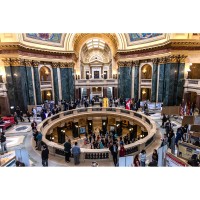
Menomonie, Wis. – From the depths of outer space to the cutting edge of cyberspace, University of Wisconsin-Stout undergraduates presented wide-ranging, impactful research March 11 at the annual Research in the Rotunda event in the Wisconsin State Capitol in Madison.
The event embodies UW-Stout’s polytechnic approach on a statewide stage, with student researchers and their faculty advisers sharing the tangible implications of their applied research in multiple disciplines, including chemistry, cybersecurity, conservation, packaging and human development.
“It’s one of the more significant events students can go to where they can experience that they are an expert,” said Professor Tina Lee, who has accompanied applied social science students to Research in the Rotunda for more than decade. Over the years, Lee has watched as student researchers have developed professional confidence presenting their research under the Capitol dome.
Nine outstanding UW-Stout undergraduates were among the roughly 125 students from all 13 Universities of Wisconsin campuses who shared their research at the 22nd annual event, which celebrates the positive economic impact of the state’s universities. Elected officials, policymakers and business leaders were among the hundreds of visitors who explored the displays, chatting with undergraduates and their faculty advisers. Gov. Tony Evers was in attendance, as was Universities of Wisconsin President Jay Rothman, who visited with UW-Stout researchers.
“Undergraduate research transforms learning,” as undergraduates apply innovative thinking, data analysis and problem solving to identify solutions, Rothman said.
“In doing so, our students gain exactly the skills that employers across Wisconsin need,” he said. “In short, these research experiences make our universities an even stronger pipeline of great talent.”
Bringing space research down to earth
Among the stratosphere-scraping undergraduate talent was UW-Stout junior Reese Hufnagel, a B.S. chemistry major who, alongside faculty adviser Professor Matthew Ray, is trying to solve the problem of reentry debris from spacecraft and satellites.
Ideally, materials such as expendable rocket stages and decommissioned satellites burn up when they fall back to earth. However, as stronger carbon-fiber materials have become more common and the number of rocket launches has increased exponentially thanks to firms like SpaceX, reentry debris has become much more common in recent years, Hufnagel explained. To address this potential danger, Hufnagel and Ray have worked to create a catalytic additive that, when integrated into carbon-fiber materials, can cause them to disintegrate when they reach a specific trigger temperature at reentry.
“I think this research is really important because it could solve one of the major issues that is being faced by the aerospace industry today,” Hufnagel said. Entities such as the European Union and the European Space Agency are at the forefront of this topic, the latter having created a Zero Debris Charter that calls for an end to space debris by 2030. “This research is a direct correlation with some of their goals and could significantly impact how people look at ‘design for demise’ when it comes to aerospace,” Hufnagel added.
To bolster their work, Hufnagel and Ray have conducted more than 50 interviews with people in the space industry, including experts at NASA, SpaceX and Sierra Space, which has a facility in Wisconsin. Among other things, the pair have formed a startup to commercialize their work, and Hufnagel has received a research scholarship from the Wisconsin Space Grant Consortium.
As Wisconsin’s Polytechnic University, UW-Stout uses the slogan “Do More on Day One,” and Hufnagel jokes she began her research on “Day Negative Two” — the weekend before she even started classes.
“I don’t think that’s something you could do at another university,” she said. “I immediately got attention from people high up, like faculty, who were able to make those kinds of decisions. I was able to start right away as an 18-year-old, starting some of this research and having access to all of the labs.”
Keeping an eye on AI agents
Two other UW-Stout undergraduates, senior Chloe Kaneski and junior Fletcher Meyer, have also researched ways to mitigate risky incidents, but in a very different kind of space. The B.S. cybersecurity majors’ work focused on using artificial intelligence agents to respond to cybersecurity threats.
Using a large language model (LLM) — specifically, one developed by Anthropic — the students programmed an AI agent to find and fix vulnerabilities in an IT system. The results were measured in terms of correctness, accuracy, effectiveness and other factors. They found that the agent could correctly identify vulnerabilities 74% of the time, but was less accurate (67%) in understanding the vulnerabilities.
“The result of the research was that there should always be a human element,” Meyer said. The AI agent, he explained, would sometimes harm a network while attempting to secure it — for example, by locking itself out without providing a means back in. “So while it can do things at great speed and great quality, there are things that — when it doesn’t match up — it does a very bad job at, and there need to be humans to validate its answers,” he added.
Kaneski said she expects her experience researching and working with AI will be an asset in the professional world.
“Especially in cybersecurity, AI is becoming a pretty big factor, so having exposure to it is going to be a good thing in the long run,” Kaneski said. “It could be valuable to employers if you can see if the tool is effective or not effective.”
Research explores multiple disciplines
Participants in Research in the Rotunda are nominated by faculty, staff and a student committee. Here is a complete list of this year’s UW-Stout student researchers, their topics and their mentors:
· Helayna Brown, of Menomonie, and Ella Kemp, of Cedar Rapids, Iowa, both applied social science: Return on Investment of the Work of County Land and Water Conservation Departments in Wisconsin. Mentors: Professor Tina Lee and Assistant Professor Nicole Hayes.
· Cayanna Erickson, of Eau Claire, environmental science: Monitoring the Zebra Mussel Invasion in Lake Menomin. Mentors: Lecturer Julia Chapman and Hayes.
· Reese Hufnagel, of Anoka, Minnesota, chemistry: The Sky is Falling: Accelerating Demise During Uncontrolled Reentry of Space Debris. Mentor: Professor Matthew Ray.
· Elias Jeska, of Somerset, environmental science: Microcystin Concentrations and Space: A Survey of Spatial and Depth Patterns. Mentor: Hayes.
· Louis Malais, of Rhinelander, human development and family studies: The Effects of Traumatic Stress on Interpersonal Relationship Characteristics. Mentor: Associate Professor Kevin Doll.
· Fletcher Meyer, of Appleton, and Chloe Kaneski, of Plymouth, Minnesota, both cybersecurity: Autonomous Al Agent for Incident Response. Mentor: Professor Holly Yuan.
· Lauren Ras, of St. Michael, Minnesota, packaging: Raspberry Packaging Design: Effects of Air Flow Rate on Raspberry Shelf Life. Mentor: Assistant Professor Mary Paz Alvarez Valverde.
Research in the Rotunda is sponsored by Kwik Trip, Wisconsin Manufacturers & Commerce, BioForward, the Wisconsin Technology Council, the Wisconsin Alumni Research Foundation and the UW-Milwaukee Research Foundation.
UW-Stout, a member of the Universities of Wisconsin, is Wisconsin’s Polytechnic University, with a focus on applied learning, collaboration with business and industry, and career outcomes. Learn more via the FOCUS2030 strategic plan.
University of Wisconsin-Stout
-
Tom Giffey Marketing Communications
- March 12, 2026
- Send Email
